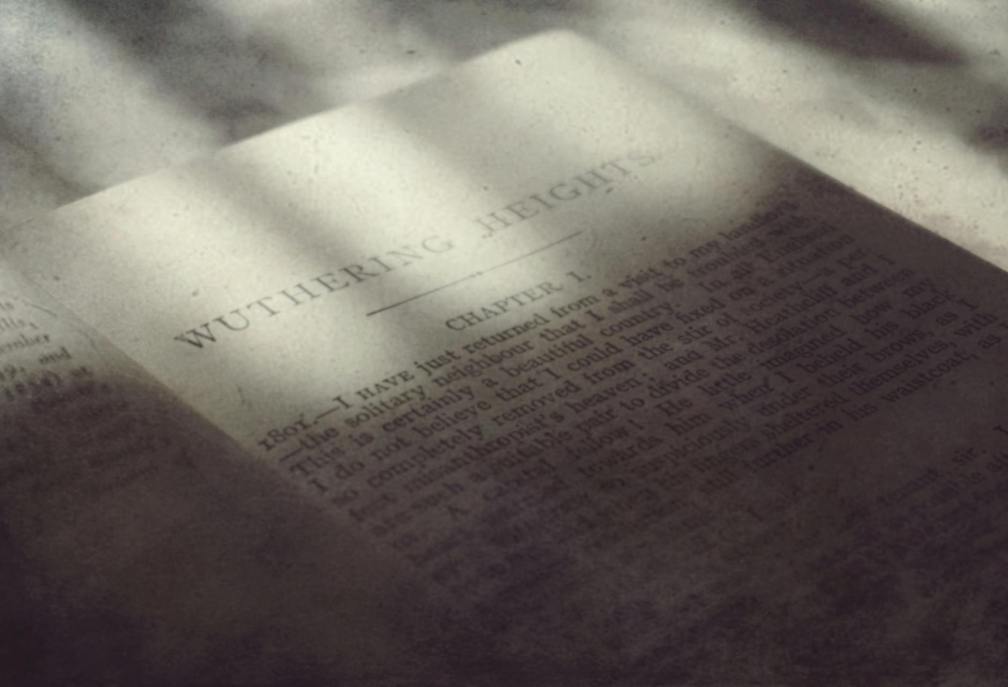
Wuthering Heights: A Haunting

“Whatever our souls are made of, his and mine are the same.”- Emily Brontë

A Tempest in Ink

There are books that do not merely tell stories- they breathe, they howl, they claw at the edges of your soul. Wuthering Heights is such a book. Emily Brontë’s tale of love, revenge, and the wild Yorkshire moors is not a romance; it is a force of nature, a storm bound in pages.

The moors themselves are a character here- a vast, untamed landscape that mirrors the raw, ungovernable hearts of Heathcliff and Catherine. Their love is not gentle. It is a wildfire, consuming everything in its path, leaving ash and echoes in its wake. Brontë does not ask us to forgive them; she asks us to understand that love, in its purest form, is as wild and untamed as the wind that sweeps the heather.

Reflections

I read Wuthering Heights curled by the fire, the wind rattling the windows like Cathy’s ghost begging to be let in. There’s a part of me that understands Heathcliff’s obsession, his refusal to let go. Love, in these woods, feels just as primal- a thing of roots and storms, not softness.

Sometimes, when I walk the moors or the tangled forest, I imagine Catherine’s voice on the wind. She is not a cautionary tale; she is a warning. A reminder that love can be a knife, a key and a curse at once.

Gothic Motifs in the Wild

Brontë’s genius lies in her ability to blur the line between the human and natural world. The moors are not a backdrop to the story, rather they are a mirror. When Catherine declares “I am Heathcliff,” she is not speaking metaphorically. She is acknowledging that they are both creatures of the same wild soil, bound by something deeper than blood or reason.

In the forest, I feel that same kinship. The trees are not scenery, they are confidants. The streams are not water, they are voices. The wind is not air, it is a chorus of ghosts.

A Ritual for the Wild Heart

  1. Gather your tools: A candle, a handful of soil. a lock of your hair.
  2. Set your intention: Light the candle and whisper “Let my heart be wild, let my soul be free.”
  3. Bury the token: Mix the soil and hair in a small bowl. Say clearly “As earth to earth, as wind to wind, let my oul be free.”
  4. Release it: Scatter the mixture outdoors, letting the wind carry it away.
  5. Give thanks: Extinguish the candle and have a moment of gratitude for the land.

Reflections

Wuthering Heights isn’t a story about love. It is a story about what happens when love becomes a tempest- when it refuses to be caged, even by death. As I turn the last page, I feel the moors stir inside me, restless and alive.

The forest, too, is a tempest. It does not ask for permission; it takes. It does not apologise, it grows. And perhaps, in the end, neither should we.

Whispers in the Dark: A Musing on Gothic Literature

“There are darknesses in life and there are lights, and you are one of the lights, the light of all lights.”- Bram Stoker, Dracula

The Allure of the Shadows

There is something irresistible about the dark. Something irresistible about the way it curls at the edges of our vision, the way it whispers secrets we can almost, but never quite, understand. Gothic literature understands this allure. It does not shy away from the shadows; instead, it steps into them, lantern in hand, and shows us the beauty that lies within.

From crumbling castles to moonlit moors, from brooding antiheroes to tragic heroines, Gothic literature is a dance between light and dark, the seen and the unseen. It is a genre that thrives on atmosphere, on the tension between what is real and what is imagined, between what is said and what is left unsaid.

The Haunting of Wuthering Heights

Take, for example, Emily Brontë’s Wuthering Heights. It is a novel that pulses with raw, untamed emotion, a story that feels less like a book and more like a living, breathing entity. The moors are not just a setting; they are a character, wild and untamed, reflecting the inner turmoil of Heathcliff and Catherine.

Heathcliff himself is the embodiment of the Gothic antihero- dark, brooding, and consumed by a love that is as destructive as it is passionate. Catherine is his equal, a woman torn between societal expectations and her own wild heart. Their love is not sweet or gentle; it is fierce, consuming, and ultimately tragic.

But it is not just the characters that make Wuthering Heights a masterpiece of Gothic literature. It is the atmosphere- the howling wind, the ghostly presence of Catherine at the window, the sense that the past is never truly gone, but lingers, haunting the present.

The Power of the Unseen

Gothic literature is, at its heart, a genre of the unseen. It is about the things that lurk just beyond the edge of our vision, the things we feel but cannot name. It is about the power of suggestion, the way a single word or image can evoke a sense of dread or longing.

In Mary Shelley’s Frankenstein, it is not the monster that is truly terrifying, but the idea of the monster- the fear of what happens when man plays god, when science oversteps its bounds. In Edgar Allen Poe’s The Tell-Tale Heart, it is not the act of murder that chills us, but the sound of the heartbeat, the creeping sense of guilt and madness.

Gothic literature is a genre that transcends itself; it is a mirror, a guide, a reminder. It shows us the beauty that can be found in darkness, the power in the unseen, and the complexity of the human heart.

So, pick up a book, and step into the shadows where the whispers are waiting and there are stories ready to be told.