Whispers From The Unseen Tongue: A Guide

“Nature is not a place to visit. It is home”

The Language of Roots and Rot

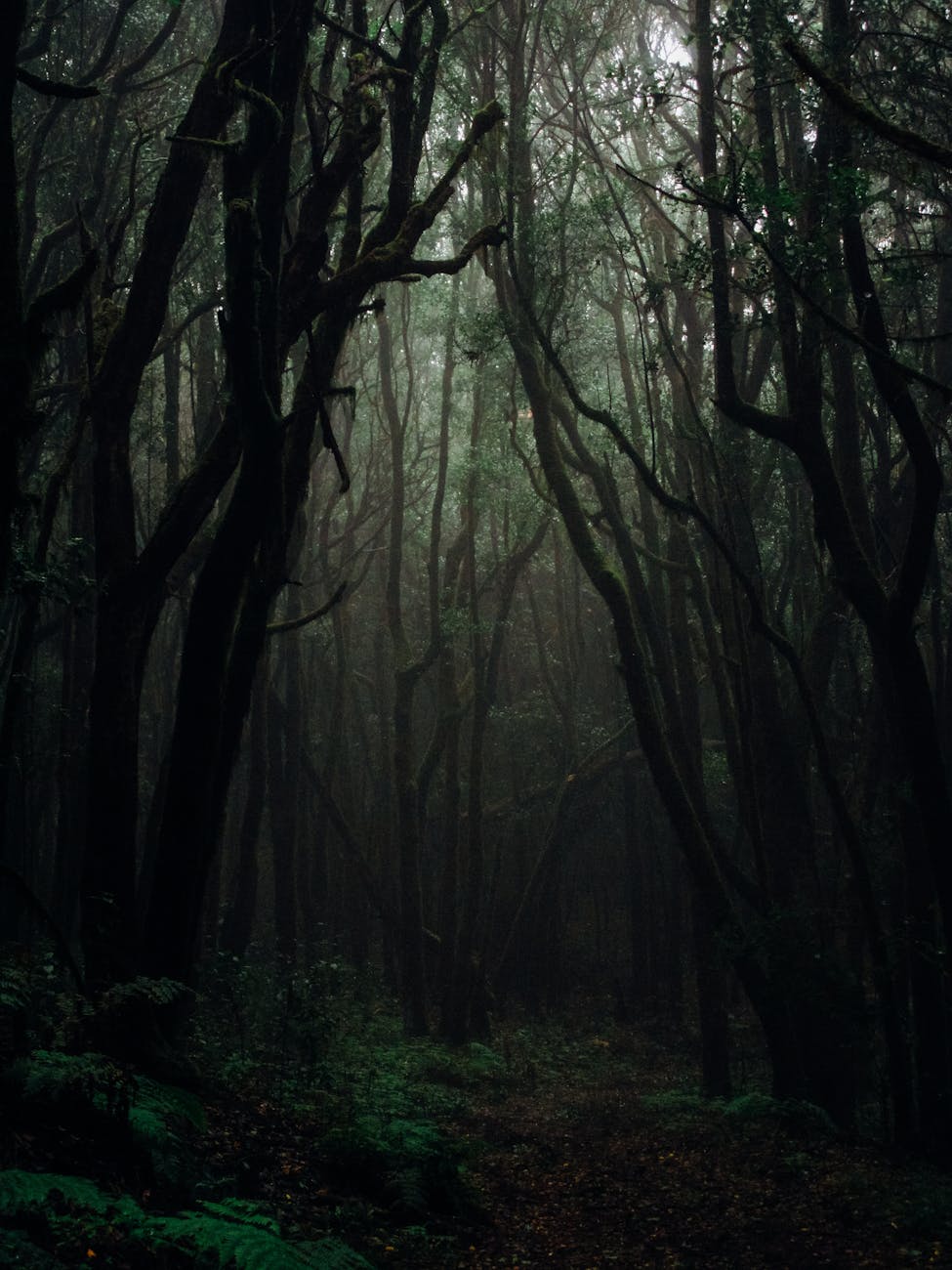
Folk magic does not shout. It murmurs in the rustle of leaves, hums in the marrow of decaying logs, and sighs through the hollows where shadows gather. To understand it, one must learn the dialects of the wind- the symbology of fungi, the omens carried on raven wings, the stories etched into bark by time and weather. Here, we wander through the lexicon of the unseen.

Trees: The Archivists of Earth

The tree is a tongue that speaks to the wind, a bridge between the living and the dead.

Trees are more than sentinels; they are living chronicles. The yew, with its blood-red berries and tocid embrace, guards graveyards as a reminder of death’s fertility. The rowan wards of restless spirits with its scarlet clusters- a beacon against the unseen. Ancient oaks anchor let lines, their roots threading through underworlds, their branches cradling starlight.

Folklore: In some Celtic traditions, carrying rowan wood protects against enchantment. To harm a hawthorn, however, invites the wrath of the fairy realms.

Fungi: The Alchemists of Decay

The mushroom is nature’s hieroglyph- a cipher written in rot and rebirth.

Fungi thrive in liminal spaces, dissolving death into life. Fairy rings- circles or mushrooms- mark gateways to Otherworld revelries, where time bends and mortal feet stumble. The fly agaric, scarlet and speckled, fuels Siberian shamans’ visions, while the death cap hides its venom in plain sight, a reminder that beauty and peril share the same soil.

Folklore: Breton lore warns that stepping into a fairy ring binds you to dance until you are freed by madness or death.

Birds: Omens on Feathered Wings

The crow’s call is a funeral dirge; the owl’s cry, a widow’s lament.

Birds are translators between realms. Ravens, Odin’s spires, carry secrets from battlefields to gods. Owls, Athenian emblems of wisdom , are also harbingers of death in Welsh myth- their hoots echoing the Ankou, a grim reaper. Even the wren, tiny and plain, holds power: Irish tradition claims it betrayed martyrs, earning its title Devil’s Bird.

Folklore: A lone magpie at dawn signals sorrow, but two bring mirth- a duality captured in a famous rhyme.

Rivers: The Veins of Memory

Water remembers what the land forgets.

Rivers are thresholds. The Styx ferries souls to Hades; the Boyne cradles Ireland’s myths. To ancient Celts, depositing swords or torcs in water honours the gods of the deep. Even today, well dressing in Derbyshire threads petals into sacred patterns, a plea for the springs’ benevolence.

Folklore: Throwing coins into wells once fed the spirits within- a pact of copper for clarity, silver for healing.

The Moon: A Mirror of the Unseen

The moon does not fight. It attacks no one. It does not worry. It simply shines

The moon’s phases are a grimoire. The new moon cloaks intentions in shadow, a time for sowing silent wishes. The full moon illuminates truths, its light a scalpel for lies. Waning crescent? A blade to sever ties. Folk magic hungers for lunar silver- charging talismans in its glow, harvesting herbs under its gaze, whispering pleas to its cold, unblinking eye.

Folklore: Romanian farmers once sowed seeds at the full moon to ensure fertility while Breton fishermen refused to set sail under a waning crescent.

Reflections

The forest speaks in riddles. A raven’s croon, a mushroom’s bloom, the way moonlight pools in a hollow stump- these are not accidents. They are fragments of a language older than temples, older than prayers. It is said the to know a thing’s name is to bind it, but perhaps the wild asks for something gentler: to listen, to kneel, to let the world’s whispers etch themselves into your bones.
Thresholds and Covenants: A Journal Entry

“The past is never dead. It’s not even past.”- William Faulkner

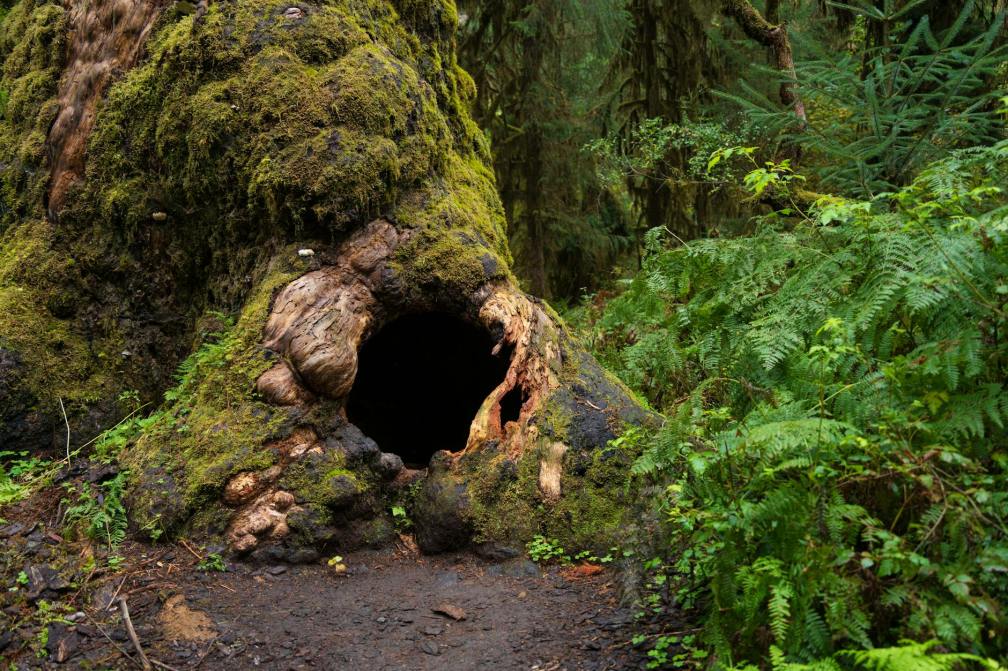
The forest is a keeper of thresholds. Rivers, crossroads, and moonlit glades are its well-known gateways, but hollow oaks- split by lightning and hollowed by time- are quieter, darker doors. I found it weeks ago, its trunk cracked like an ancient tome, its roots cradling secrets older than the village beyond the trees.

Inside, wrapped in linen the colour of a weathered bone, lay a blade. Not rusted, thought its edge was dull. Not ornate, though its hilt bore runes that prickled the skin like static. It hummed in my palm, a sound felt more than heard, as if vibrating in tune with the marrow of the world.

The Language of Unseen Things

Hollow trees are not mere shelters for owls or foxes. In Celtic lore, they are portals to the fairy realms. Offerings of milk or bread are left to appease their keepers, but this blade was no offering. It was a key. Or a lock. Or both.

The runes defied translation. Not like anything I have seen before- perhaps something older, something ties to the nameless things that walked the woods before the stones I stumble on were set in place. The blade’s purpose lingers just beyond reach, like a word forgotten mid-sentence.

Dreaming

The blade now rests on my desk, next to dried hawthorn and a jar of storm water. It hums at odd hours, a sound that slips into dreams. Last night I dreamt of a weaver that was not weaving, but instead unravelling. Threads snapped like sinew as she laughed.

I woke with dirt beneath my nails, the journals pages smudged with ink and a refrain echoing through my mind: not all doors should be opened. Coincidence? The forest does not deal in coincidence.

Reflections

I returned the blade to its oak today. Left it swaddled in fresh lines, a sprig of rue, and three drops of blood- an offering, apology, and plea. The wind hissed through the hollow but whether in acceptance or scorn, I cannot say.

The forest guards its thresholds jealously. Some secrets are not meant to be found. Some blades are not meant to be held.

The Poisoner’s Garden: Herbs of Shadow and Light

“Double, double toil and trouble; Fire burn and cauldron bubble.” – William Shakespeare

The Duality of Roots

In the moonlit corners of the poisoner’s garden, where shadows cling like loyal familiars, grow herbs that defy simple categorisation. They are both healers and destroyers, keys to visions and locks on forbidden doors. Tonight, we wander among two of those enigmatic herbs. Handle them with reverence- or regret.

Belladonna: The Silent Siren

Deadly nightshade, fairest of poisons

Belladonna’s glossy black berries and star shaped flowers have lured the curious to their doom for centuries.

A History Steeped in Blood and Vision

A plant with ancient origins, named Atropa Belladonna for the Greek goddess Atropos, the Fate who cuts the thread of life. Roman assassins dipped arrows in its sap, while priestesses of Delphi allegedly inhaled its fumes to commune with Apollo’s oracle. The use of Belladonna as a poison was known as far back as Roman times, with rumours claiming that Livia Drusilla used it to murder her husband, the emperor Augustus.

By the Middle Ages, it became a key ingredient in a ‘flying ointment’ said to be used by witches to induce trances. The hallucinogenic alkaloids (atropine, scopolamine) blurred the line between ecstasy and agony, birthing tales of broomstick flights and Sabbaths with the Devil.

In the middle ages, Venetian women dripped its juice into their eyes to dilate pupils- a dangerous fashion trend immortalised in its name, meaning beautiful lady. Even Goethe wrote of its allure in Faust where it symbolises forbidden knowledge.

Mandrake: The Screaming Root

Mandrake, the little man of the earth.

Its forked root, said to scream when pulled from the soil, has fuelled legends from Babylon to Hogwarts.

A Root Wrapped in Myth and Terror

In Ancient Egypt, Mandrake was buried in pharaohs’ tombs as a gateway to the afterlife. The Hebrew Bible references it as a fertility charm, with Rachel bartering mandrakes for Jacob’s love (Genesis 30:14-16). The myth of mandrake was further deepened in Greek lore as Hippocrates prescribed it for melancholy, albeit sparingly, while Dioscorides warned in De Materia Medica that its cry could kill harvesters. Pliny the Elder claimed sorcerers wore it as an amulet to defy fate.

In Medieval Europe apothecaries sold mandrake manikins- carved from bryony roots, claiming they guarded against plague and poverty. German folklore said they grew beneath the gallows from the semen of hanged men. Shakespeare himself immortalised the dread of mandrakes in Romeo and Juliet: “Shrieks like mandrakes torn out of the earth.”

Reflections

Belladonna and mandrake are not merely plants- they are mirrors. They reflect humanity’s oldest obsessions: the hunger for transcendence, the fear of mortality, the dance between sin and salvation. To walk their history is to walk a knife’s edge, where poison and cure are divided by a breath.

I gather these with gloved hands, and a humbled heart. They remind me that every garden holds graves, every remedy a requiem.

This post explores historical and folkloric uses of plants. They are toxic and should only be handled with the utmost care.

Shadowed Blooms: The Dark Language of Petals

“The pedigree of honey Does not concern the bee; A clover, any time, to him Is aristocracy.”- Emily Dickinson

Whispers in Petals

Flowers are not merely beautiful. They are spies. They are messengers. They are mourners. Long before words failed us, we have them voices- crimson roses for passion, lilies for purity, rosemary for remembrance. But in the shadowed corners of floriography, there blooms a darker lexicon: flowers that speak of betrayal, of longing, of secrets buried deep in the soil.

Let us wander through the unseen garden. Let us learn the language of flowers that grow where the light dares not linger.

Flowers of the Forgotten

Nightshade: Beware the beauty that blinds

Its berries gleam like polished onyx, its blooms a velvet purple. A flower of danger, delirium, and the veil between life and death. In the Victorian language of flowers, it does not speak, it whispers: I am your undoing.

Black Rose: Love, darkened by time

A rose dyed black by moonlight and sorr0w. It speaks of farewells, of love that persists beyond the grave, of vows made in shadows. It wails: My heart is yours, even in decay

Yew: Eternity’s Sigh

Its scarlet berries and evergreen needles mark gravesides. It stands, now as always, a sentinel between worlds. It murmurs: I remember. I wait.

A Bouquet for the Lost

I gathered my flowers at dusk, their petals trembling in the half-light. The nightshade from the edge of the forest, the rose from a forgotten garden, the yew from the churchyard where the stones lean like wary watchers. Together they form a bouquet of unspoken truths- a language for the secrets I cannot name.

There is a love here, tangled in thorns. A love that refuses to die, even as it poisons the soil. A love that waits, patient as the yew, for a reunion I cannot yet fathom.

A Ritual for Speaking Without Words

  1. Gather your tools: A black ribbon, a candle, and three flowers
  2. Set your intention: Light your candle and whisper the name of the one you wish to reach.
  3. Bind the flowers: Imbue into them your intention silently. Consider who you are wishing to reach, and why. Feed the blooms with your questions.
  4. Bury or Burn: To release, burn the bouquet letting the smoke carry your message. To preserve, bury the bouquet in soil where roots will cradle your words.
  5. Give thanks: Extinguish your candle, and leave a drop of honey as a thank you.

Reflections

The forest taught me that growth and decay are lovers, entwined in an endless dance. These flowers are their emissaries- beautiful, lethal, eternal.

I press the nightshade between the pages of my journal, its petals leaving stains like old ink. Somewhere, in the silence between heartbeats, I hope I am heard.

Murmurs in the Mist: A Journal Entry

“I am the only being whose doom No tongue would ask, no eye would mourn.”- Emily Brontë

The Morning’s Veil

I woke to a world swallowed by fog. The forest was a ghost of itself- trees reduced to silhouettes, the path ahead dissolved into a haze of silver and grey. Even the birds were silent, their songs muffled by the weight of the mist. I followed the stream, its voice the only guide, a murmur beneath the stillness.

The water was black as ink, reflecting nothing but the void above. I knelt to drink, and for a moment, my own face stared back- pale, fractured, a stranger’s visage rippling in the current. The forest does this: mirrors your doubts, your fears, the parts of yourself you’ve buried like bones.

The Language of Loss

I found something today. Half-buried in the mud, corroded by time, was a locket. Its chain was broken, its clasp rusted shut. When I pried it open, the inside was empty- no portrait, no lock of hair, just a hollow where memory once lived.

Who wore this? A lover? A lost soul? Or someone like me, who wandered too deep and forgot the way back? The locket hummed in my palm, cold and insistent. I slipped it into my pocket. Some questions aren’t meant to be answered yet.

With the fog this thick, the way was unclear. I gathered a cup of stream water, a feather and a candle. I held the feather above the water and asked for guidance through this unseen place. I dipped the feather into the water and traced a path over my skin, anointing myself. I lit the candle and allowed flame to burn the tip of the feather. The smoke curled upwards in the mist, its shape revealing a map.

Reflections

The fog has lifted now, but the locket stays with me- a reminder that loss is not an end, but a thread. Every empty space holds the echo of what once was, and every echo is a call to keep walking.

The forest is patient. It knows I will return, lantern in hand, to ask the questions I am not ready to voice yet.

First Light: A Journal Entry

“The woods are lovely, dark and deep, But I have promises to keep, And miles to go before I sleep” – Robert Frost

The Forest at Dawn

I woke to the sound of birdsong, their melodies weaving through the trees like threads of light. The forest was alive, breathing, stirring beneath the first rays of the sun. I don’t know how I came to be here, but the air feels different- thicker, somehow, as if it holds secrets just out of reach.

I walked for hours, my feet carrying me over moss-covered stones and through streams that glittered like liquid silver. The forest is vast, endless, and yet it feels familiar, as if I’ve walked these paths in dreams. There is a strange comfort in the unknown, a sense that I am exactly where I need to be, even if I don’t yet understand why.

The Language of the Land

The forest speaks in a language I am only beginning to understand. The rustle of leaves, the creak of branches, the distant call of a fox- it is a symphony, a story, a spell. I found myself stopping often, my hand resting on the rough bark of a tree, my eyes tracing the patterns of light and shadow on the forest floor.

I gathered a few things as I walked- a feather, a smooth stone, a sprig of a wild herb. They feel like gifts, tokens from the land itself. I don’t know what they mean yet, but I sense they are important, that they hold some kind of message or meaning.

A Strange Longing

There is a feeling I can’t quite name- a longing, or a pull, or a whisper at the back of my mind. It is as if I have forgotten something vital and that it sits just out of reach. The forest seems to know, though. It watches me with quiet patience, as though it is waiting for me to remember.

I sat by the stream for a long time, my fingers trailing in the cool water. The current carried leaves and twigs, and I wondered where they were going, what they would find. Perhaps I am like those leaves, carried by a current I cannot see, toward a destination I cannot yet imagine.

The forest is a mystery, but a friend. It does not give its secrets easily, but I sense that it is leading me somewhere… that it is showing me something I need to see.

I don’t know what tomorrow will bring, but for now, I am content to wander, to listen, to learn. The forest is patient, and so am I.

The Language of Flowers: Whispers of Petals, Secrets of the Wild

“The earth laughs in flowers”- Ralph Waldo Emerson

A Tapestry of Petals

In the quiet corners of the garden, where the sunlight dances on dew-kissed petals, there is a language older than words. It is a language of colour, scent and shape- a language that speakers of love, loss, and longing. This is the language of flowers, a secret code woven into the very fabric of nature.

For centuries, flowers have been more than just the ornaments of the earth. They have been messengers, carrying hidden meanings and unspoken emotions. A single bloom can tell a story, convey a feeling, or whisper a secret. To understand the language of flowers is to step into a world where every stem is a symbol and every blossom is a piece of the soul.

A History of Floriography

The language of flowers, or floriography, reached its height of popularity during the Victorian era, when strict social codes made open expression of emotions difficult. Flowers became a way to communicate what could not be said aloud- a bouquet of roses for love, a sprig of rosemary for remembrance, a cluster of violets for loyalty.

But the roots of floriography run much deeper. In ancient Greece, flowers were tied to myths and gods. Narcissus for vanity, hyacinth for grief, laurel for victory. In the Middle Ages, herbs and flowers were used in religious rituals and medicinal practices, their meanings intertwined with their healing properties.

Even today, the language of flowers lingers in our collective memory. We give red roses on Valentine’s Day, lilies at funerals, and daisies to celebrate innocence. These traditions are echoes of an ancient language, a reminder that flowers are more than just beauty. They are symbols, stories, and secrets.

The Stories They Tell

Each flower has its own story and voice. The rose, with velvety petals and thorny stem, speaks of love and passion, but also of mystery and farewell. In Greek mythology, the rose was born from the tears of Aphrodite, the goddess of love, a symbol of beauty born from sorrow.

Lavender, with its soft purple blooms and calming scent, whispers of devotion and purity. In Medieval Europe, it was believed toward off evil spirits and protect against the plague, its fragrance a shield against the unseen.

Ivy, with its winding tendrils and evergreen leaves, tells of fidelity and eternal bonds. In ancient Rome, it was sacred to Bacchus, the god of wind and revelry, a reminder that even in celebration, there is connection and growth.

The daffodil, with its golden trumpet and delicate petals, heralds renewal and hope. In Greek mythology, it is tied to the story of Narcissus, who fell in love with his own reflection- a reminder that beauty can be both a gift and a curse.

And the poppy, with its crimson petals and dark centre, speakers of sleep, peace, and oblivion. In ancient Greece it was associated with Demeter, the goddess of harvest, and used in rituals to honour the dead- a symbol of rest and remembrance.

A Ritual for the Language of Flowers

To honour the language of flowers, try this ritual:

Find a quiet space, perhaps a garden or a sunlit windowsill, and choose a flower that resonates with your heart. Hold it gently in your hands, feeling its texture, its weight, its life. Whisper your intention to it- a wish, a memory, a hope. Then, please it somewhere sacred: in a vase, pressed between the pages of a journal, or tucked behind your ear.

As you do this, let the flower’s meaning guide your thoughts. Let its story become your story, its voice your voice. In this small act, you are not just honouring the flower- you are stepping into the ancient language of the earth, becoming part of its tapestry.

The language of flowers is not just a relic of the past; it is a living, breathing connection to the earth and to each other. It is a reminder than beauty and meaning are everywhere, if only we take the time to look.

So, next time you walk through a garden or wild meadow, listen closely. The flowers are speaking. What will they tell you?